Trump Accounts 101: Is Your Child Eligible for $1,000?

Picture of Kevin Dick

Kevin Dick

Posted on Jan. 2, 2026

Overview

With the passage of the One Big Beautiful Bill Act (OBBBA) in July 2025, the federal government established a new, federally sponsored investment account for children called “Trump Accounts.”  While these accounts can generally be thought of as a cross between traditional individual retirement accounts (IRAs) and 529 savings accounts, it’s important to note that Trump Accounts are neither of these things.  

When a Trump Account is opened, the federal government contributes $1,000 as an initial deposit.  The funds grow on a tax-deferred basis until the child turns 18, at which point they assume ownership of the account.

FAQ

Every U.S. citizen born between January 1, 2025 and December 31, 2028 is eligible to participate in a Trump Account.

In a recent development, American businessman Michael Dell and his wife, Susan, have pledged over $6 billion to support Trump Accounts.  As part of this initiative, the first 25 million children age 10 and under who meet certain eligibility criteria may receive an additional $250 contribution to their account. So, in short, if your child is under 10 years old you should still check to see if they’re eligible for $250. 

The White House says it’s pursuing additional philanthropic donations in the near future, which could further expand the program, however nothing has been announced yet.

The easiest way to open a Trump Account is by electing to do so when filing your federal taxes.  You will also have the ability to open an account through an online portal which will be available Summer 2026.

Once enrolled, accounts will begin receiving funds in July 2026.

Yes.  Charles Schwab is widely recognized for its support of broader access to investing and has publicly supported this program.

Parents, guardians, family members, friends, and employers are all authorized to contribute to Trump Accounts.  Each account can receive up to $5,000 in total contributions per year per beneficiary.  The $5,000 contribution limit is indexed to inflation and will begin adjusting after 2027.

Employers may contribute up to $2,500 per year towards an employee’s or an employee’s child’s Trump Account without it counting towards the employee’s taxable income (although this amount continues to count against the $5,000 annual limit).  Employer contributions are also generally tax-deductible.

Certain charities, non-profits, and governmental organizations may also contribute, provided they do so in a broad, non-selective manner.

A beneficiary who is earning income is also eligible to contribute to their own Trump Account.

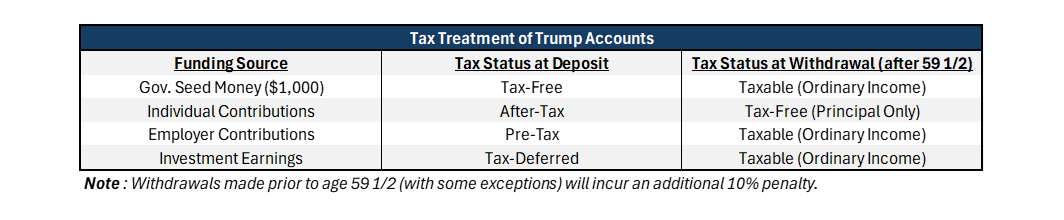
Employer contributions up to $2,500 are excluded from the employee’s taxable income.  They are also tax deductible to the employer.

All other contributions are treated as gifts, which means they are NOT tax deductible.  Although, earnings in the account grow on a tax-deferred basis.

Investments in Trump Accounts are limited to certain low-cost mutual funds and exchange traded funds (ETFs) that track major U.S. stock indices such as the S&P 500.

Funds are ineligible for withdrawal before January 1st of the calendar year the beneficiary reaches age 18.  However, after that point, the beneficiary will take over the account and it will generally be treated like a traditional IRA and subject to the same general rules as one.

Like with IRAs, withdrawals from Trump Accounts for higher education or a first home purchase will not be penalized for early withdrawal.  Though, the amount withdrawn will still be subject to ordinary income tax.

We recommend checking in with www.trumpaccounts.gov periodically to make sure you are getting the most up-to-date information.  On the bottom of the government’s website, you also have the option of subscribing to receive email notifications for any updates.

This content is provided for informational purposes only and should not be relied upon in any manner as professional advice, or an endorsement of any practices, products or services. There can be no guarantees or assurances that the views expressed here will be applicable for any particular facts or circumstances, and should not be relied upon in any manner. You should consult your own advisers as to legal, business, tax, and other related matters concerning any investment.